Explain a Chromosome Insertion and the Effect It Can Have on a Human.
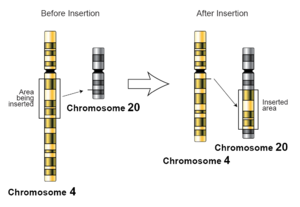
An illustration of an insertion at chromosome level
In genetics, an insertion (also called an insertion mutation) is the addition of one or more nucleotide base of operations pairs into a DNA sequence. This can oft happen in microsatellite regions due to the DNA polymerase slipping. Insertions can be anywhere in size from one base of operations pair incorrectly inserted into a Dna sequence to a section of one chromosome inserted into some other. The mechanism of the smallest unmarried base insertion mutations is believed to exist through base-pair separation betwixt the template and primer strands followed past not-neighbor base stacking, which tin occur locally within the DNA polymerase active site.[ane] On a chromosome level, an insertion refers to the insertion of a larger sequence into a chromosome. This can happen due to unequal crossover during meiosis.
Northward region addition is the addition of not-coded nucleotides during recombination by terminal deoxynucleotidyl transferase.
P nucleotide insertion is the insertion of palindromic sequences encoded by the ends of the recombining gene segments.
Trinucleotide repeats are classified as insertion mutations[2] [iii] and sometimes as a divide grade of mutations.[iv]
Effects [edit]
Insertions can be especially hazardous if they occur in an exon, the amino acrid coding region of a gene. A frameshift mutation, an alteration in the normal reading frame of a gene, results if the number of inserted nucleotides is not divisible past three, i.e., the number of nucleotides per codon. Frameshift mutations will modify all the amino acids encoded by the gene following the mutation. Usually, insertions and the subsequent frameshift mutation will cause the active translation of the factor to encounter a premature terminate codon, resulting in an end to translation and the production of a truncated protein. Transcripts carrying the frameshift mutation may as well be degraded through Nonsense-mediated decay during translation, thus not resulting in whatsoever poly peptide production. If translated, the truncated proteins frequently are unable to office properly or at all and can possibly consequence in any number of genetic disorders depending on the gene in which the insertion occurs. Methods to observe DNA sequencing errors were developed.[5]
In-frame insertions occur when the reading frame is non altered as a event of the insertion; the number of inserted nucleotides is divisible by three. The reading frame remains intact afterward the insertion and translation will most probable run to completion if the inserted nucleotides practice not lawmaking for a finish codon. Withal, because of the inserted nucleotides, the finished protein will contain, depending on the size of the insertion, multiple new amino acids that may touch the function of the protein.
See also [edit]
- Indel
- Insertional mutagenesis
- Loss-of-Role Mutations
- Proceeds-of-Function Mutations
- Deletion (genetics)
References [edit]
- ^ Banavali, Nilesh K. (2013). "Partial Base Flipping is Sufficient for Strand Slippage about Dna Duplex Termini". Journal of the American Chemical Society. 135 (22): 8274–8282. doi:x.1021/ja401573j. PMID 23692220.
- ^ "Mechanisms: Genetic Variation: Types of Mutations". Evolution 101: Agreement Development For Teachers. Academy of California Museum of Paleontology. Archived from the original on 2009-04-fourteen. Retrieved 2009-09-19 . ] Agreement Evolution For Teachers Home. Retrieved on September 19, 2009
- ^ Brown, Terence A. (2007). "sixteen Mutations and DNA Repair". Genomes three. Garland Scientific discipline. p. 510. ISBN978-0-8153-4138-three.
- ^ Faraone, Stephen Five.; Tsuang, Ming T.; Tsuang, Debby Westward. (1999). "5 Molecular Genetics and Mental Affliction: The Search for Disease Mechanisms: Types of Mutations". Genetics of Mental Disorders: A Guide for Students, Clinicians, and Researchers. Guilford Press. p. 145. ISBN978-ane-57230-479-6.
- ^ Shmilovici, A.; Ben-Gal, I. (2007). "Using a VOM Model for Reconstructing Potential Coding Regions in EST Sequences" (PDF). Periodical of Computational Statistics. 22 (1): 49–69. doi:x.1007/s00180-007-0021-eight. S2CID 2737235.
Further reading [edit]
- Pierce, Benjamin A. (2013). Genetics: A Conceptual Approach (fifth ed.). Due west. H. Freeman. ISBN978-i-4641-5084-5.
Source: https://en.wikipedia.org/wiki/Insertion_(genetics)
0 Response to "Explain a Chromosome Insertion and the Effect It Can Have on a Human."
Post a Comment